

Contact us
If you are interested in cooperation, please contact us immediately, we will give you feedback as soon as possible!


17
2025
-
12
5 Scenarios Where Timing Belt Linear Modules Crush Ball Screw Designs (And Save You Money)
Author:
The article outlines five applications where timing belts outperform alternatives: Long strokes (>3m): No whipping issues, cuts costs by 45%, and halves cycle time. High-speed cycling (>2m/s): Quiet, efficient, boosts productivity by 38%, with near-zero maintenance. Multi-station light/medium loads: Multiple sliders on one axis enable parallel operation, speeding up processes with fewer motors. Dusty environments: Enclosed design slashes downtime by 75%. Budget projects: Delivers 31% lower total cost of ownership over 5 years.
Ever watched your high-speed camera or sensor nail the job in milliseconds—only to wait forever for the linear axis to catch up?
One factory engineer told me: “Our vision system processes in 5 ms. The ball screw takes 250 ms to position. The real bottleneck? Mechanics, not software.”
This frustration is common in automation. That's where timing belt linear modules (also known as belt-driven linear actuators) outperform traditional ball screw linear modules. They're not superior everywhere—but in specific cases, they slash cycle times, cut maintenance, and drop costs by 30-50%.
Drawing from 10+ years helping factories optimize motion, here are five real scenarios where timing belts win big. (All based on actual projects and data.)

The Core Difference: Precision vs. Speed & Scale
Ball screw modules: Like a high-end watch—super accurate, rigid, perfect for heavy loads and short strokes. But limited by "critical speed" (vibration/whipping on long or fast runs).
Timing belt modules: Like a bullet train—lightweight, no speed limits, excels at long distances and quick acceleration.
Quick specs comparison:
- Accuracy: Ball screw ±0.01mm; Timing belt ±0.05-0.1mm
- Max Speed: Ball screw ~1.5 m/s; Timing belt 3-5+ m/s
- Stroke: Ball screw practical <3m; Timing belt 10m+ (splicable)
- Load Capacity: Ball screw for heavy/vertical; Timing belt mid-light excels
- Maintenance: Ball screw regular greasing; Timing belt almost none
Now, the scenarios where belts dominate.
Scenario 1: Long Strokes Over 3m – Belts Run Away with It
Ball screws beyond 2-3m need thicker shafts to prevent whipping—prices skyrocket.
Real example: Logistics sorting line, 5m stroke. Ball screw capped at 1.2 m/s. Switched to timing belt linear module: reached 4 m/s, cycle time from 18s to 9s, throughput +45%. System cost? 55% of the screw version.
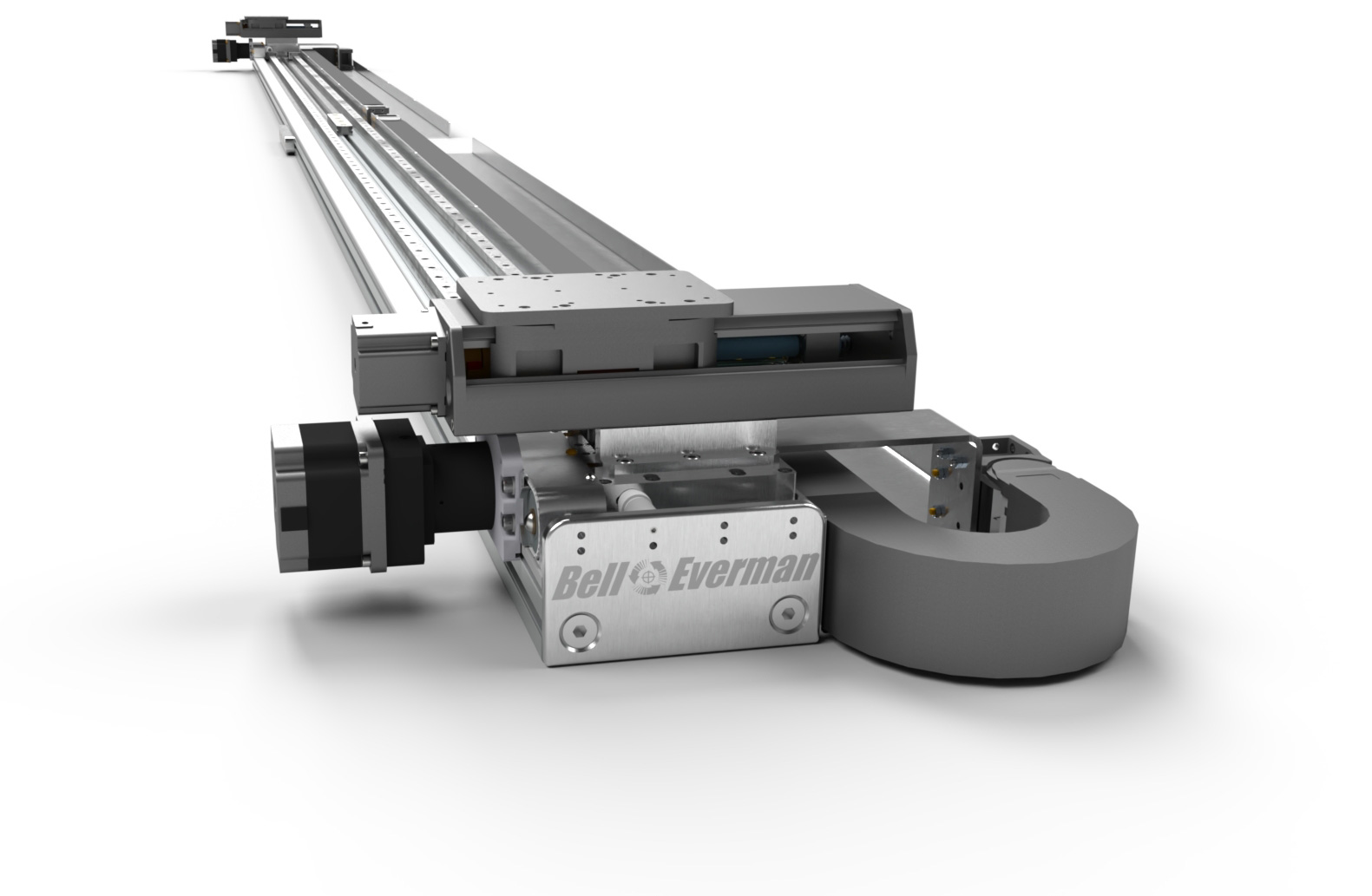

Why belts win: No critical speed, simple tensioning, easy extension.
Scenario 2: High-Cycle Speeds Needing >2 m/s
Screws heat up, wear fast, and get noisy at high speeds.
Example: Electronics packaging. Ball screw at 1.4 m/s caused yearly $15k+ rebuilds. Timing belt hit 3.8 m/s quietly, zero lube needed, output +38%, maintenance near zero.
Key advantages:
- Lower inertia = faster accel/decel
- Efficient (>90%) even at full duty
- Smooth, vibration-free runs
Scenario 3: Mid-Light Loads with Multi-Station Handling
For loads under 60kg, screw rigidity is overkill—belts are lighter, cheaper, flexible.
Example: Food processing with 10 stations. One timing belt module with multiple independent carriages did parallel picks—30% faster than screw gantries, saved two motors and controllers.


Wins:
- Multi-carriage on single belt
- Great for cobot extensions (low added mass)
- Often 40% lower upfront cost
Scenario 4: Dusty or Low-Maintenance Environments
Screws trap contaminants, demand frequent lubrication. Enclosed belts? Virtually maintenance-free.
Example: Woodworking transfer line. Ball screws replaced every 8 months from sawdust. Fully enclosed timing belt ran 4+ years with one belt swap—downtime slashed 75%.
Why ideal: Excellent dust sealing, belt life 20,000+ km
Scenario 5: Budget-Conscious Projects Demanding Reliability
Screws: Higher buy-in + ongoing costs.
Numbers: 5-year TCO, similar 8-axis setup—ball screw ~$480k vs. timing belt ~$330k (31% savings).
Example: Mid-size battery plant tight on capex. Timing belt met all specs, freed $150k for extra stations.
Fast Decision Matrix: Belt vs. Screw
| Factor | Go Ball Screw If... | Go Timing Belt If... | Edge Winner |
|---|---|---|---|
| Stroke | <3m | >3m | No vibration, unlimited length |
| Speed | ≤1.5 m/s | >2 m/s | Faster cycles, quick accel |
| Precision | Need ±0.01mm | ±0.05mm OK | Better value |
| Load | Heavy (>80kg) or vertical lift | Mid-light (<60kg) | Lighter system, lower inertia |
| Maintenance | Can schedule regular service | Want minimal/no upkeep | Near zero downtime |
| Budget/TCO | Precision justifies premium | Cost & ROI priority | 30-50% savings long-term |


Final Thoughts
Ball screw linear modules remain unbeatable for ultra-precision, heavy loads, short strokes. But when your bottleneck is speed, distance, upkeep, or budget? Timing belt linear modules deliver massive ROI—many clients kick themselves for not switching sooner.
If you're hitting motion limits on a current line, it's worth a quick audit.
What's your biggest motion headache right now—slow cycles, high maintenance, or scaling costs? Share in the comments; I reply to every one.
Or head to www.www-robot.com for a free selection guide and quote tailored to your specs.
Thanks for reading—hit like if this helped, and follow for more straight-talk automation insights.
lm guide,ball screw,robot gripper , electric cylinder ,linear guide rail ,ball screw drive ,timing belt drive


HIGH-TECH ENTERPRISE
AUTOMATED PRODUCTION
Contact Us
> Whatsapp: +86 13360462722
> Email: whywlb1@gmail.com
> Address: 9th Floor, Zone C, Songhu Zhigu
Industrial Building, No. 9 Yanhe South Road, Liaobu
Town, Dongguan City